A unified system for managing your equipment fleet
Equipmetry Fleet brings operations, maintenance, repairs, spare parts and finances for the entire fleet into a single loop. Every vehicle and machine has one complete profile that shows everything needed for effective management — control over the fleet and every unit across all management layers: operations, technical condition, finances, documents and staff.
More than 3,000 vehicles and machines are already connected to the platform
Fleet reports are flawless — as long as people are the ones compiling them
Fleet operations have more than 34 points where losses can occur. A fleet rarely loses a lot at once — it loses a little, constantly: fuel, hours, repairs, spare parts, shifts, downtime.
Each individual leak is unnoticeable and always has an explanation. Together they consume up to 12–25% of fleet spend — and it comes not out of revenue, but out of the thin margin everything depends on.
Everyone in your fleet knows the specific facts.
The mechanic knows the vehicle was idle. —
The driver knows where he really was. —
The dispatcher knows the work order was closed just for show. —
The only one who doesn't know is the one paying for all of it.
By the time the summary reaches your desk, it has shed everything inconvenient and lands there neatly polished.
And the numbers add up — which is the most alarming part of all.
One machine, one profile
At the core of Fleet is a single piece of equipment. Everything that happens to it flows into one profile, from two categories of sources.
Where the facts come from
Sensors
Engine hours, location, route and fuel consumption are recorded by the equipment itself. This data isn't entered by a person — it's captured by onboard hardware and telematics. It can't be padded or written off on someone's word.
It can't be padded or written off on someone's wordProcess chain
Everything else — work orders, parts issuance, job closure, documents — moves through a controlled chain: approval, comparison against norms, plan-vs-actual matching, automatic anomaly checks. Every step is logged, and any edit stays visible in the history.
Every step is logged, and any edit stays visible in the historySix loops, one fleet
Each loop covers its own area of fleet operations. They all run on the same data — the unit's own profile — so they never contradict one another. At the bottom, everything converges into finance and analytics.
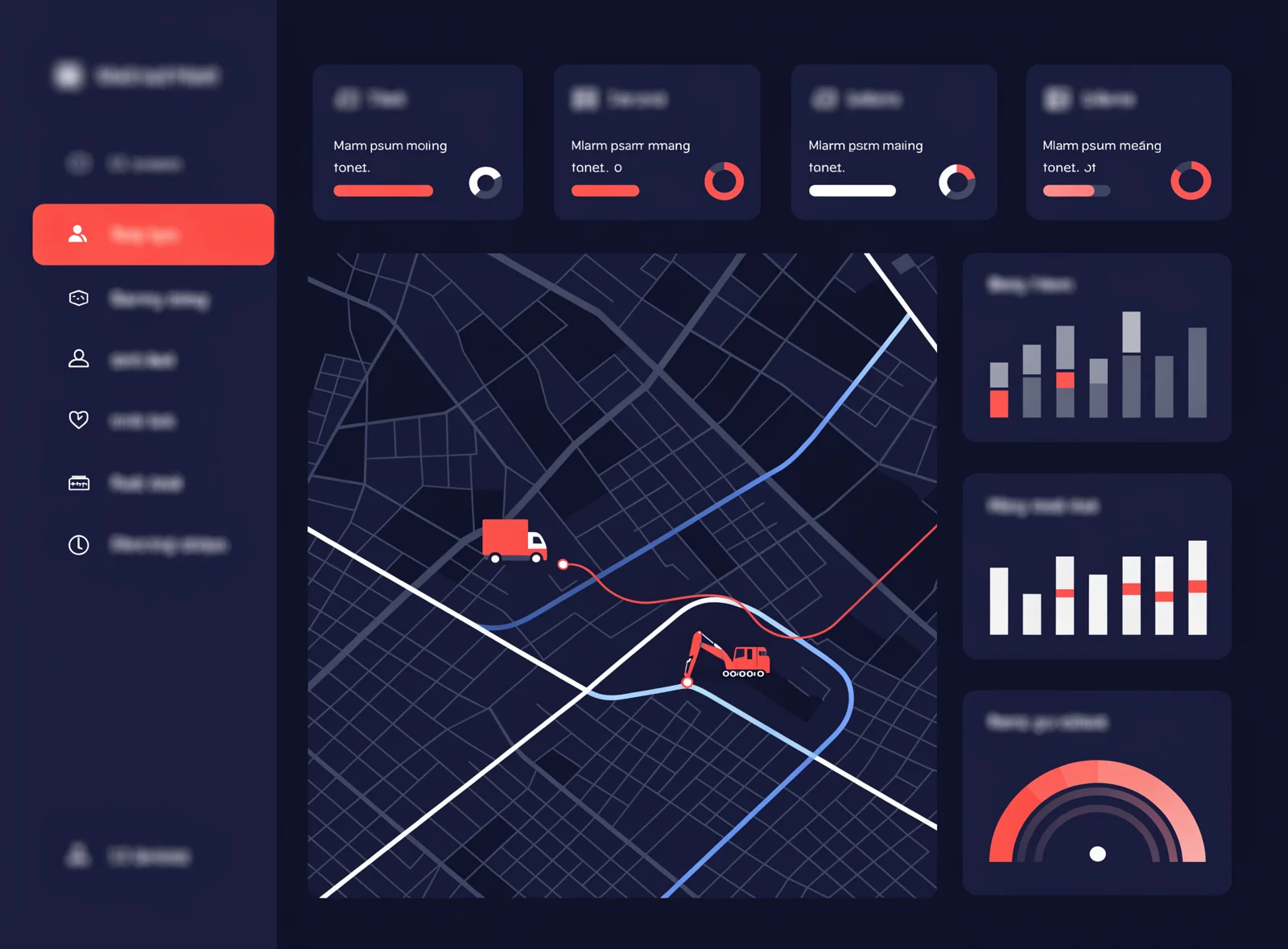
Where every unit is right now and what it's doing. A real-time fleet map, telemetry, tracks, project geofences, predictive alerts — deviations are visible before they turn into breakdowns.
Maintenance by plan, not by memory. Scheduled maintenance programs, planned preventive repairs, regulatory inspections. The scheduler allocates work across the fleet based on staff availability and the task queue.
From "something's wrong" to a closed repair. Defect logging, work order, execution, acceptance — in-house or at an external service station. Every repair is tied to the machine; the work order shows who did the work and with what qualification.
Spare parts matched to work orders. Stock levels, issuance for specific jobs, shortage replenishment through procurement with supplier bids, price control. It's visible what was installed and which machine it was written off against.
Fuel is under control at every step, from receiving into company tanks to write-off against a specific piece of equipment. Tank levels, refueling, consumption norms, card transactions. The system reconciles the balance and flags discrepancies.
Costs tied to a project. Working hours, fuel, repairs and parts for each unit are allocated to a specific site, with utilization confirmed by geofences. It's visible exactly how much the project cost in equipment terms.
Finance and documents
Costs with a traceable source. Invoices, contracts, acceptance certificates, work-completion reports and waybills are compiled from operations automatically, with export to 1C. Every expense is tied to a piece of equipment and its approval.
Analytics
Cost of ownership, downtime, reliability, consumption and project cost are all compiled from the same operations. Not separate reports someone assembles by hand, but a cut of data that's already been validated at the point of entry.
AI that gets used every day
We spent a long time searching for where AI in a fleet-management system delivers real value. The answer turned out to be with mechanics and technicians. Three tools passed the test of daily use and stayed in the product.
Defect analysis
The mechanic describes the fault in their own words or attaches a photo. AI suggests the likely cause, the affected assembly and a standard fix. Diagnosis happens faster, especially for less experienced staff.
What changes in monetary terms
The impact is made up of several line items, each calculated separately. Below is a selection of the most common sources of economic impact from using Equipmetry Fleet.
Working in Equipmetry Fleet, you get the working metrics and ready-made business processes that deliver the main impact.
Integrations. Works with what you already have set up
Fleet doesn't require replacing your telematics or accounting system. Data comes in from your existing sources, and documents go straight to your accounting department.
Telematics and GPS
Connect to several providers simultaneously if the fleet is assembled from different systems. Equipmetry Fleet can also work with any third-party system that transmits data.
Accounting systems
Invoices, acceptance certificates, work-completion reports and write-offs are exported from the same operations that closed the work order, timesheet or other operational document.
Government data
Parts catalogs
The item is matched by part number and goes straight into the work order and the warehouse request.
Maps
Tracks, project geofences, routes.
Notifications and access
Sign-in via corporate Microsoft Azure AD or any other SSO.
Who runs on Fleet
Fleets ranging from several hundred to one and a half thousand units, including light machinery and rail-car stock.
Fleet of specialized equipment and light machinery
Fleet of specialized equipment and light machinery
Equipment fleet and rail-car stock
And other companies in logistics, manufacturing and the agricultural sector
How the rollout works
Rollout happens in six steps across three phases.
First, a survey of the fleet and processes; then configuration to match your procedures and telematics integration; then go-live with on-site training and support.
See Fleet in action
Get in touch and tell us about your business. We'll discuss how we can help, and show you the system live.